
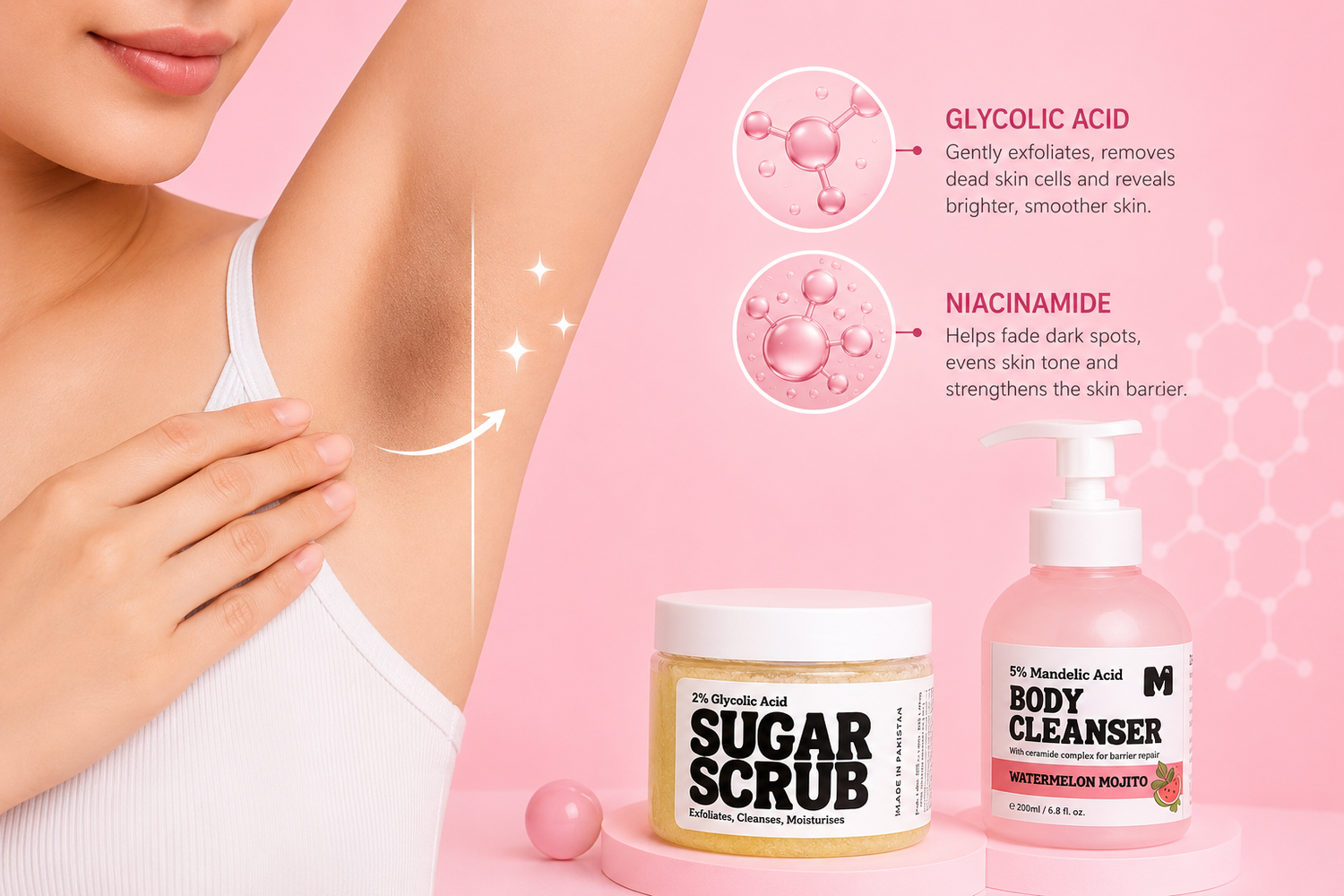
- 1. Why Are Dark Underarms So Common?
- 2. Why Do Underarms Get Dark?
- 3. What's Actually Making Your Underarms Darker
- 4. The Ingredients That Actually Work — And Why
- 5. The Exact Routine to Follow
- 6. What to Stop Doing Immediately
- 7. How Long Will It Take?
- 8. FAQs
- 9. The Short Version: What to Do Starting Tonight
Why Are Dark Underarms So Common?
Dark underarms are one of the most Googled skin concerns in Pakistan — and one of the least talked about out loud.
If you've ever avoided sleeveless outfits, felt self-conscious at the beach, or tried every home remedy you found on Instagram with zero results — you're not alone, and you're not doing anything wrong.
Dark underarms are not a hygiene problem. They're a pigmentation problem. And pigmentation has very specific causes and very specific solutions.
This guide skips the lemon juice advice (please stop rubbing lemon on your skin) and gets straight to what dermatologists and skin scientists actually recommend — explained in a way that makes sense.
Why Do Underarms Get Dark?
Your underarm skin is one of the most sensitive areas on your body. It faces friction every single day — from movement, clothing, and hair removal. Every time your skin experiences irritation or damage, it defends itself by producing more melanin. More melanin = more pigmentation = darker skin.
This is called Post-Inflammatory Hyperpigmentation (PIH) — and it is the most common cause of dark underarms in Pakistani women.
But it's not the only cause. Here's the full picture:
What's Actually Making Your Underarms Darker
1. Shaving
This is the biggest culprit — and the most overlooked.
When you shave, the razor does not just cut hair. It also scrapes the top layer of your skin every single time. That repeated micro-trauma signals your skin to produce more melanin as protection. Over months and years of daily shaving, the underarm skin becomes chronically inflamed and progressively darker.
Shaving also leaves the dark hair root visible just below the skin surface — which creates a shadow effect that makes underarms appear even darker than they are.
What to do instead: Switch to waxing, laser or threading. These methods remove hair from the root, which eliminates the shadow effect and causes less long-term pigmentation than daily shaving.

2. Friction from Tight Clothing
Pakistan's fashion — fitted kameez, tight sleeves, synthetic fabrics — creates constant friction against the underarm. This daily rubbing triggers melanin production the same way shaving does.
What to do: Wear loose, breathable cotton on days you are at home. Give your underarm skin a break from constant friction.
3. Alcohol-Based Deodorants
Most budget deodorants available in Pakistan contain alcohol, artificial fragrance, and harsh preservatives. These are all irritants on sensitive underarm skin. Chronic irritation = chronic melanin response = chronic darkening.
What to do: Switch to fragrance-free, alcohol-free deodorants. Your underarm skin will calm down within a few weeks of switching.
4. Dead Skin Cell Buildup
This one is simple. Underarms, like all body skin, accumulate dead skin cells. When these are not removed through regular exfoliation, they sit on the surface and make the area look dull, thick, and dark — even when there's no actual deep pigmentation.
What to do: Gentle exfoliation 2–3 times a week removes this buildup and immediately brightens the area.
5. Hormonal Changes
This is the most common cause that home remedies simply cannot fix. Hormonal imbalances — particularly elevated insulin or conditions like PCOS — can trigger a skin condition called Acanthosis Nigricans. This causes dark, velvety thickening of the skin in underarms, neck, and inner thighs.
Important: If your underarm skin is not just dark but also thick and velvety in texture, see a doctor. This can be a sign of insulin resistance and needs medical evaluation, not just a skincare routine.
6. Post-Waxing Inflammation
Waxing is better than shaving long term — but the act of waxing itself causes short-term inflammation. If you do not care for your underarm skin after waxing, that repeated inflammation can still cause PIH over time.
What to do: Apply a Niacinamide or Ceramide-based product to your underarms after every waxing session to calm inflammation before it triggers pigmentation.
The Ingredients That Actually Work — And Why
Let's be very direct: lemon juice, baking soda, potato juice, and turmeric paste are not evidence-based treatments for dark underarm pigmentation. Some of them — particularly lemon juice and baking soda — can actually worsen pigmentation by disrupting your skin's pH and causing more irritation.
Here is what actually works:
Niacinamide — The One You Need First
Niacinamide (Vitamin B3) is the most important ingredient for dark underarms — full stop.
It works by blocking the transfer of melanin from melanocyte cells to the surface of your skin. Less melanin transfer = lighter, more even skin tone over time. It also strengthens the skin barrier, reduces inflammation, and calms the chronic irritation that causes darkening in the first place.
Best for: All types of underarm pigmentation, all skin types, daily use.
Safe for: Post-waxing skin, sensitive skin, year-round use.
Timeline: 6–8 weeks of daily use for visible results

Why it's the first ingredient to use: Niacinamide works on the pigmentation pathway without causing sun sensitivity — meaning you can apply it morning and night, summer and winter, without any risk of making pigmentation worse.
Kojic Acid — For Stubborn, Deeper Pigmentation
Kojic Acid works by inhibiting tyrosinase — the enzyme your skin uses to produce melanin. Less melanin production at the source means existing dark patches gradually fade and new ones do not form as easily.
It is more targeted than Niacinamide and works well for older, more stubborn pigmentation that has not responded to gentler ingredients.
Best for: Deep, long-standing underarm pigmentation.
Glycolic Acid or Mandelic Acid — For Exfoliation
Chemical exfoliants remove dead skin cell buildup from the surface without the friction damage of physical scrubs. This reveals brighter skin immediately and also helps your brightening ingredients (Niacinamide, Kojic Acid) absorb better.
Use Code MMB5 and get 5% discount
Glycolic Acid works faster and is better for those whose skin tolerates it well.
Mandelic Acid is gentler and better for sensitive skin or those who are new to chemical exfoliation.
Use: 2–3 times a week as part of a body scrub or exfoliating wash on the underarm area.
Never use on freshly waxed skin — wait at least 48 hours after waxing before exfoliating
Ceramides — For Barrier Repair After Hair Removal
Every time you wax or shave, your skin barrier takes a hit. Ceramides repair this barrier, reduce inflammation, and prevent the post-hair-removal irritation that causes pigmentation.
Use: Apply a Ceramide-rich body lotion or emulsion immediately after every waxing session
The Exact Routine to Follow
This is the routine. Keep it simple and stay consistent.
Daily Morning Routine
Step 1 — Cleanse Wash your underarms with a gentle, fragrance-free body wash. Avoid deodorant soap bars on this area — they are too harsh for sensitive underarm skin.
Step 2 — Apply Niacinamide Treatment Apply your Niacinamide body emulsion or lotion to dry underarm skin. Let it absorb for 2–3 minutes before putting on clothes.
Step 3 — Fragrance-Free Deodorant If you use deodorant, apply it only after your Niacinamide treatment has fully absorbed. Use a fragrance-free, alcohol-free formula.
Night Routine (Every Night)
Step 1 — Cleanse Remove sweat, deodorant, and product buildup from the day.
Step 2 — Exfoliate (2–3 nights a week only) Apply your Glycolic Acid or Mandelic Acid scrub or wash to the underarm area. Rinse thoroughly. Do not exfoliate every night — this worsens irritation.
Step 3 — Apply Kojic Acid or Niacinamide Treatment On exfoliation nights: apply Niacinamide after rinsing off the exfoliant. On non-exfoliation nights: apply Kojic Acid as your targeted treatment 3–4 times a week.
Step 4 — Moisturize Finish with a lightweight Ceramide body lotion to seal everything in and repair the barrier overnight.
After Waxing (Special Care)
- Do not apply any actives for 24–48 hours after waxing
- Apply a Ceramide or Aloe-based lotion immediately after to calm inflammation
- Resume your Niacinamide routine after 24 hours
- Do not exfoliate for at least 2 days post-waxing
Expert Tip: The 48 hours after waxing are the most critical for preventing pigmentation. Freshly waxed skin is inflamed. Anything that further irritates it in those 48 hours — actives, fragrance, tight clothing, sweat — increases the melanin response. Keep it calm and clean.
What to Stop Doing Immediately
These are the habits that are actively making your dark underarms worse — even if they feel like they're helping.
Stop: Rubbing Lemon on Your Underarms
Lemon juice is acidic (pH around 2) — far more acidic than your skin's natural pH of 4.5–5.5. It disrupts your skin barrier, causes irritation, and increases sun sensitivity. On dark underarm skin that already has compromised barrier function, lemon juice can worsen inflammation and trigger more pigmentation.
Lemon contains citric acid — yes. But it is not a controlled concentration and it has no moisturizing or barrier-supporting properties. Glycolic Acid or Mandelic Acid do the same exfoliation job safely and effectively.
The fix: Use a properly formulated chemical exfoliant instead.
Stop: Scrubbing Hard
Aggressive scrubbing feels productive but creates more micro-damage, more inflammation, and more pigmentation. The underarm area is thin and sensitive. Friction is what caused the darkening in the first place — more friction is not the solution.
The fix: Exfoliate gently with a sugar scrub or chemical exfoliant, 2–3 times a week maximum.
Stop: Using Bleach or Fairness Creams
Unregulated fairness creams — especially those that promise "instant whitening" — frequently contain mercury, high-dose hydroquinone, or corticosteroids. These thin the skin, cause rebound darkening, and with prolonged use can cause permanent damage to sensitive underarm skin.
The fix: Use Niacinamide and Kojic Acid. They are clinically studied, safe for long-term use, and actually work.
Stop: Switching Products Every Two Weeks
If a product does not show results in 14 days, that does not mean it is not working. Skin cell turnover takes 28–40 days. Brightening treatments need at least 6–8 weeks to show visible results. Switching products constantly means you never give anything long enough to work.
The fix: Pick a routine. Stick to it for 8 weeks. Then evaluate.
How Long Will It Take?
Be honest with yourself about this — because the number one reason body care routines fail is unrealistic expectations.
| Type of Pigmentation | Expected Timeline |
| Mild surface dullness (dead skin buildup) | 1–2 weeks with regular exfoliation |
| Recent PIH (from waxing or shaving last few months) | 6–8 weeks of consistent routine |
| Established pigmentation (1–2 years) | 3–4 months of consistent routine |
| Long-standing deep pigmentation (years) | 4–6 months minimum, may need dermatologist |
| Hormonal (Acanthosis Nigricans) | Requires medical treatment first |
The most important thing to understand: consistency beats intensity every single time. A simple Niacinamide + Kojic Acid routine used every day for 3 months will outperform any expensive cream used randomly for 2 weeks.
FAQs
Q: Can dark underarms go back to my natural skin tone completely? A: For most women — yes, with the right routine and enough time. PIH-based darkening from shaving and friction can fully fade. Hormonal or genetic darkening may improve significantly but not always completely.
Q: Is it safe to use Kojic Acid on underarm skin? A: Yes, when used correctly — 3–4 nights a week as a targeted treatment, not daily. Underarm skin is sensitive, so avoid using it on freshly waxed or irritated skin.
Q: Can I use these products during summer? A: Absolutely. Niacinamide is safe year-round. Kojic Acid and exfoliants should be used at night, and you should apply SPF if your underarms are exposed to sun (sleeveless tops).
Q: What's better for underarms — waxing or shaving? A: Waxing causes less long-term pigmentation than daily shaving. Shaving leaves a visible shadow and causes chronic micro-damage to the skin surface. Waxing removes hair from the root, which eliminates the shadow effect and reduces daily friction.
Q: My underarms are dark AND itchy — is that normal? A: Occasional mild itching after waxing or with dry skin is normal. But persistent itching, redness, or a rash could signal an allergic reaction to a product, contact dermatitis, or a skin condition. If it does not clear up in a week, see a dermatologist.
Q: Can men use this routine? A: Yes — dark underarms affect men just as commonly. The same ingredients and routine apply.
Q: I have PCOS. Will this routine still work? A: Partially. If your darkening is hormonal (Acanthosis Nigricans), topical treatments alone will not give full results. Managing the underlying hormonal condition with your doctor combined with a consistent skincare routine gives the best outcome.
The Short Version: What to Do Starting Tonight
If you want to simplify all of this into the most important steps:
- Stop shaving — switch to waxing
- Switch your deodorant — fragrance-free, alcohol-free only
- Exfoliate gently 2–3 times a week with Glycolic or Mandelic Acid
- Apply Niacinamide every day — morning and night
- Apply Kojic Acid at night — 3–4 times a week as a targeted treatment
- Be consistent for 8 weeks before evaluating results
That's it. No lemon juice. No potato. No baking soda. Just ingredients that are proven to work, used consistently.
Shop the Routine:
Everything you need is in The Magic Molecules body care range — formulated with the exact ingredients covered in this guide.
→ Shop Niacinamide Body Care | Shop Kojic Acid | Shop All Body Care
Want to understand your full body care routine? Read our complete guide: → Body Care Routine for Pakistani Women: The Complete Guide